Go Metric | Metric Conversion | Metric System

kilogram

How to define a kilogram

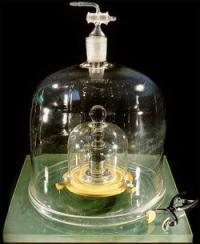
The official kilogram. Credit: BIPM

By Margaret Harris


Pick the correct definition of a kilogram:

a) the mass of a body with a de Broglie wavelength of 6.626069311 × 10^-34 m at a velocity of 1 m/s

b) a mass of a body at rest such that Planck’s constant h is 6.626069311 × 10^-34 Js

c) a mass of exactly 5.0184512725 × 10^25 unbound carbon-12 atoms at rest in their ground state

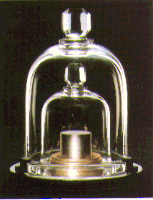
d) the mass of a lump of platinum-iridium sitting under three vacuum jars in a French laboratory

Sphere of influence - silicon 28

metric sphere

120 year old cylinder that defines the world standard for one kilogram to be replaced by sphere of silicon 28


The 120 year old International Prototype that defines the world's standard for the mass of one kilogram, held at the International Bureau of Weights and Measurement in Paris (BIPM), is set to be replaced by a perfect silicon crystal sphere developed by scientists at Australia's CSIRO. According to the CSIRO, the international scientific community, under the auspices of the BIPM, decided to focus on several methods for redefining the kilogram. One of those was the Avogadro Project that sought to bring together enough atoms of one substance to make the perfect kilogram. The sphere was made from one isotope: silicon 28.

Kilogram Redefinition


Metric kilogram
UK scientists working towards a redefinition of the kilogram

Scientists at the National Physical Laboratory (NPL) have released new research results that could affect how we measure a kilogram — the last SI unit based on a manufactured object. The International System of Units (SI) is the foundation for all our measurements from the beer in your pint to the gap between the tick and the tock on your clock.

SI units are defined by the General Conference on Weights and Measures. The next meeting of the conference, in November 2007, will consider a range of issues related to the maintenance of the SI, including an initial proposal to prepare for the redefinition of several of the base units.

A KILOGRAM JUST IS NOT WHAT IT USED TO BE


Metric kilogram
Fun fact: prototype mysteriously losing weight

The 118-year-old cylinder that is the international prototype for the metric kilogram, kept tightly under lock and key outside Paris, is mysteriously losing weight -- if ever so slightly. Physicist Richard Davis of the International Bureau of Weights and Measures in Sevres, southwest of Paris, says it appears to have lost 50 micrograms compared with the average of dozens of copies.

For scientists, the inconstant metric constant is a nuisance, threatening calculation of things such as electricity generation. But for most people, it won't mean anything. "The kilogram will stay the kilogram, and the weights you have in a weight set will all still be correct," Davis said.

Syndicate

Syndicate content

email metrication.us