Go Metric | Metric Conversion | Metric System

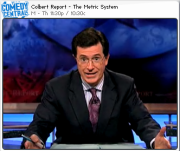
Stephen Colbert - Comedy Central - The Metric System


Metric tutor
Video: Satiric Metric System

No, we don't have a perfectly good measuring system! We have a clumsy, entangled, confusing measuring system! Only 4 countries not using metric system, Galon is buffalo skull size. TIME: 02:29

click on the play button and watch video:

Slashdot   Slashdot It!

source: www.comedycentral.com
Comments

Metric sucks

The Imperial System: If it ain't broke, don't fix it.

US customary sucks

But it is broken

If you go to buy carpeting, and you need 100 square feet, the carpet costs $10 per square yard, could you, even given these simple numbers, ever figure out how much you'll pay? Which is more, 2 quarts, 5 pints or 36 fl oz? How many pints are in a gallon? How many pounds are 200 ounces? Which drill is the larger - the 13/64, the 1/4 or the 5/32? Two cities on a map are 10 inches apart - what is their real world distance?

Do you have to default on these questions?
Then you have a problem - a problem called English Imperial system.

Not broken

It does suck, but it's not broken by your argument.

It's easy to figure out that there's 9 square feet in a yard, therefore you need at least 12 square yards (keeping numbers even) which is $120, unless you want to try to get by with 11 at $110 and put a 1 ft x 1 ft planter to cover up the hole in the corner.

5 pints is more.

8 pints in a gallon (or 128 fluid ounces)

12.5 pounds.

1/4 inch is the largest bit.

The distance between the two cities really depends on the scale of the map, not which measurement system is used. If the scale is 1 inch = 100 miles, then the cities are 1,000 miles apart. If it is 1 cm = 100 kilometers, then the cities are approximately 2,540 km apart.

The questions you posed are not difficult to answer. In fact, I didn't even have to use any conversion tables or look up any references or even write anything down. I just employed some basic math skills with knowledge gained over 20 years ago. The questions do require some knowledge other than the base 10 numerical system and the memorization of the exponential power of specific measurement prefixes, but that doesn't equate to broken. Broken implies that it doesn't work or isn't usable. Based on the fact that I was able to provide answers to your questions, it appears pretty usable to me, though I agree it isn't the best system.

Why is metric better?

I agree, you can use it, you just must put more time, work and effort, but metric is much better.

Why is metric better?

Because it's so much simpler and easier to use.

The metric system is an improvement over the English system in three major points:

1. One unit of measurement for each physical quantity. No matter from which other quantities of the SI system derived, yields always the same unit.
2. Scalability by prefixes - combinations of prefix and unit make for a plethora of convenient combined units.
3. Decimal system - fractions are expressed in decimal notation. Not only makes this the notation unique, exhaustive and intuitively comparable, but also allows unit conversion without doing math - simply by shifts of the decimal point.

Consistency makes it better

Personally, I agree that metric is better, but one could argue that your second point - while contributing to consistent naming - counts against ease of use. For example, how many prefixes for measurements are there (I honestly don't know without looking them up, but I can think more than 10 off the top of my head)? Which is bigger, deca- or deci-? In the US system, it's not much more difficult to remember that inch < foot < yard < mile, or that gallon > quart > pint > cup > fl oz.

Also, people who have trouble with fractions, I would bet, would also have trouble telling you which number is smaller: .5 or .25.

And anytime you talk about unit conversion, you are doing math intrinsically and still have to understand the relationship of one prefix to another. Comparing 0.2 cm and 134 mm still requires knowledge of how to convert cm to mm or vice-versa.

Consistency makes it better

first part: about difficulty to remember prefix. well, I'm metric born person, so I see foot system more difficult and prefix is easier for me.

second part: no doubt about it, bud you can also write it 0.50 and 0.25 with fractions you have not this option

third part: Again, I'm metric born, so I just move decimal point - conversion done. or I did'n get your point.

same vith celsius
0 C - water frozen
37 C - body temperature
100 C -water boiling

I never got F, how it works?

The third-part was kind of a

The third-part was kind of a nitpick. Moving the decimal to get from cm to mm is actually doing math intrinsically. While it may be second nature to you to get 0.2 cm to mm, you are using your knowledge that 1 cm = 10 mm and solving the algebraic formula 0.2/1 = x/10 or in short x = 0.2*10 = 2.

As for temperature:
32 F = water freezing
98.6 F = body temperature
212 F = water boiling

Not sure about the sense behind those numbers though. To go off-topic, we should really just convert to Kelvin.

Note that 98.6 is a

Note that 98.6 is a conversion from 37 C (which is why the 0.6).

Kelvin would be nice, but Celsius is more convenient as water is widely used in day to day measures (and similarly, the mass -> volume -> length relationship in metric is very useful).

the imperial system is long

the imperial system is long broke. That's why the rest of the world fixed it by using, or converting to, the metric system. Dumb America hasn't yet figured this out. Still, maybe one day America will figure it out and convert. After all, it costs America around $50 billion a day to keep the imperial system. Surely America doesn't like wasting this kind of money....does it?

Syndicate

Syndicate content

email metrication.us
